WHY MOST SMALL BUSINESS AD CAMPAIGNS FAIL BEFORE THEY EVER GO LIVE — AND THE THREE THINGS YOU NEED IN PLACE BEFORE YOU SPEND A DOLLAR
Most small business owners who come to me frustrated with ads have one thing in common.
They skipped the foundation.
Not because they're bad at business. Because nobody told them the foundation existed. They saw an ad platform, they had a product or service worth selling, and they started spending money. Reasonable assumption. Wrong order of operations.
Here's a story that captures it perfectly.
A guy came to me running ads for his pet waste removal business. He was spending fifty dollars a day on Facebook. The ad was a video of his morning routine — no offer, no hook, just him getting ready to go pick up dog poop. Six days. Three hundred dollars. Zero leads.
The ad wasn't the problem. The foundation was.
What the foundation actually is
When someone sees your ad and clicks it, that's not a sale. That's the beginning of a trust check. In the two to three minutes after someone clicks your ad, most of them are going to do a quick verification. They'll visit your website. They'll Google your business name. They'll check your reviews. They'll look at your Facebook page.
If any of those things look unprofessional, outdated, or sketchy — they're gone. The ad did its job. Everything else didn't.
This is why you can run ads without the foundation and still get some results — typically a two to five times return on a good day. But that's the ceiling. Every person who clicks and lands somewhere that doesn't look legit is a wasted impression you paid for.
Get the foundation right and that same ad spend starts compounding instead of leaking.
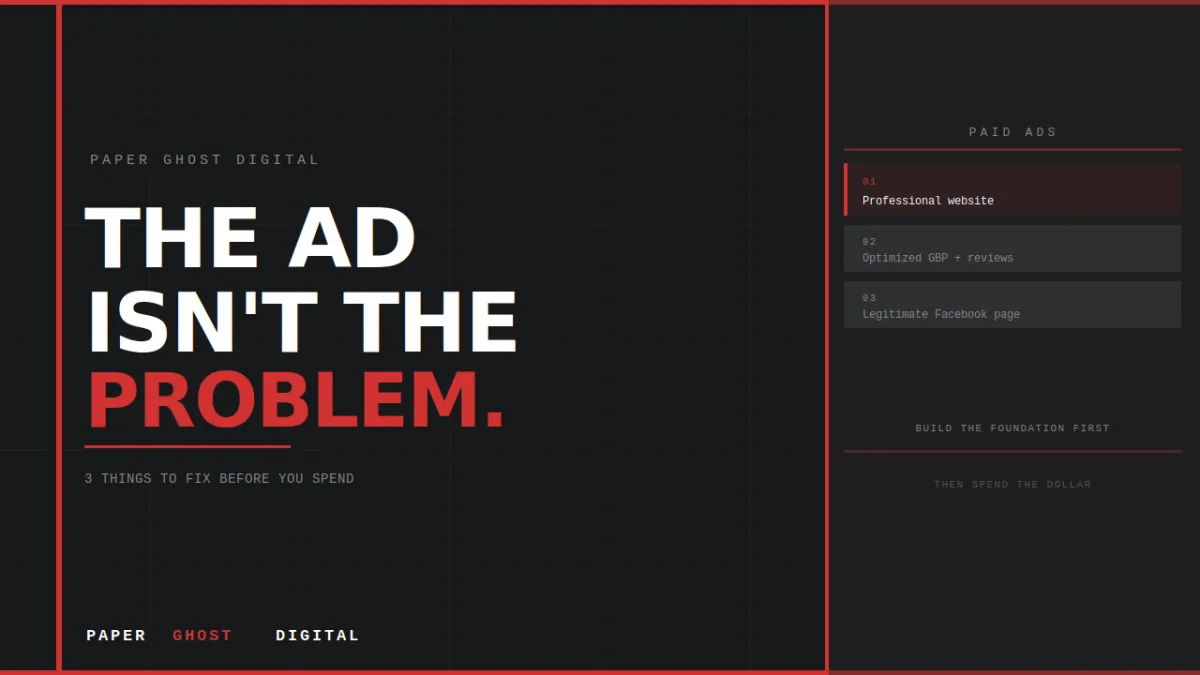
There are three pieces to the foundation. Here's each one.
1. A professional website
Your website is your online storefront. It's the first place most people go after seeing your ad to verify you're a real business worth working with.
If it looks like it was built ten years ago and nobody touched it since — that's a problem. If there are broken links, no SSL certificate, or the email address listed is a personal Gmail with a nickname in it — that's a problem. If it doesn't load properly on a phone — that's a problem.
None of this requires an expensive redesign. It requires a clean, fast, mobile-friendly site that makes someone feel like they're dealing with a legitimate business. That's the bar. Clear, credible, and professional.
When your ad sends someone to your website that site needs to earn their trust in about three seconds. If it doesn't you just paid for a bounce.
2. An optimized Google Business Profile with consistent reviews
Here's something most people don't know: your Google Business Profile and your website SEO are completely independent systems.
Your website could be ranked number fifty on Google and your GBP could still show up number one in the local map pack. They run on separate algorithms. Which means you don't have to wait six months for SEO to kick in before you can win on Google. You can optimize your GBP right now — fill it out completely, upload photos, post on it regularly, and most importantly get consistent reviews coming in — and start showing up at the top of local searches this week.
Reviews are not just an SEO signal. They are a credibility multiplier for your ads. When someone sees your ad and then Googles your business name, what they find is either a reason to trust you or a reason to keep looking. Four reviews from two years ago is a reason to keep looking. Forty seven recent reviews from real customers is a reason to call you.
The key word is consistent. Not ten reviews one time. New ones coming in regularly. That's what signals to a potential customer that you're active, working, and worth trusting.
3. A legitimate Facebook business page
When your ad runs on Facebook and Instagram, the first thing someone sees before they read a single word of your offer is your business name and your logo. That's it. That's the entire first impression.
If your business name is your personal name or something that sounds like a random handle — people scroll past. Not because your offer is bad. Because it doesn't look like a real business. People don't do business with handles. They do business with businesses.
Same goes for your logo. If it's pixelated, outdated, or just a photo of the front of your building, it signals unprofessional before anyone reads your headline. Your banner image should be clean and on brand. Your post history should show an active business that actually shows up. Your contact information should be complete and accurate.
Build this page like it's the front of your store. Because when you're running ads, it is.
Where to start with ads
Once those three things are in place, the question becomes where to run your first campaign.
For almost every local service business the answer is Meta — Facebook and Instagram. Nine times out of ten.
The reason is simple. The cost per lead on Meta is the most reasonable of any major ad platform. For most local service businesses with a correctly set up campaign you can get cost per lead down to three dollars or less. That means a hundred dollar ad spend could put thirty plus leads into your pipeline.
Meta also has everyone. It doesn't matter if you're a pool cleaner, a custom home builder, a med spa, a restaurant, or a marketing agency — your audience is on Facebook and Instagram. You can target by location, interest, behavior, and a dozen other factors. No other platform gives you that combination of reach, targeting precision, and affordable cost per lead.
Google Ads, TikTok, LinkedIn, YouTube — they all have their place and their time. But they cost more and require more existing data to optimize. Start on Meta, collect your data, learn what messaging works, and then scale to other platforms with the knowledge you've already paid for.
What to optimize for
If you're a service business running ads there's one metric that actually matters: cost per lead.
Not cost per click. Not impressions. Not reach. Not engagement.
Cost per lead.
A click means someone was curious. A lead means someone raised their hand and said I might want to work with you. That's the number that connects directly to revenue and that's the number you should be watching, optimizing, and trying to drive down over time.
When a lead comes in your job is speed. Five minutes or less to follow up. Call them. If they don't answer, text them. Move them into your pipeline. The ad gets them in. Your follow-up system closes them.
The bottom line
You can run ads without any of this. A lot of people do. But you're fighting uphill the entire time — paying for traffic that leaks because the foundation isn't there to catch it.
Get the website right. Build your GBP and get consistent reviews coming in. Set up your Facebook page like a real business. Then run your ads.
Same budget. Same targeting. Completely different results.
The ad was never the problem. The foundation was.