Why Your Email List Is the Only Audience You Actually Own
Your social media following can disappear overnight. Your email list can't.
That's not a hypothetical. It's happening right now, every day, to businesses and creators who built everything on a platform they don't control.
There was a Christian YouTube channel — based out of India, team of people running it — making around $30,000 a month almost entirely from AdSense. Then YouTube decided the channel used too much AI and demonetized it. Instantly. No warning, no real explanation. Just gone. They had no recourse. They had no list. They had no backup. Their income essentially evaporated because they put everything into someone else's hands.
That's the risk nobody talks about when they tell you to "grow your audience."
The Platform Problem
When you post on Facebook, Instagram, YouTube, or LinkedIn, you're building on rented land. The platform owns that relationship. They decide who sees your content, what the algorithm rewards, and whether your account stays up.
They can change the rules tomorrow. They can decide your content violates terms of service — and they don't have to explain why. You can ask. They can say "read the terms." End of conversation.
For Paper Ghost Digital, the odds of that happening are slim. But slim isn't zero. And "slim" is still someone else's decision, not mine. I don't want Mark Zuckerberg or Google or anyone else holding the keys to my audience.
The smarter play is treating social media as what it actually is: the top of your funnel. Not the whole thing.
What You Actually Own
Your email list. Your SMS list. The contacts you've collected directly — name, email, phone number — from people who opted in.
Nobody can take that from you. There's no algorithm. There's no platform policy that wipes it out. The only person who can remove someone from your list is that person, by unsubscribing. That's it.
Everything else is borrowed. Your email list is yours.
The Simple System
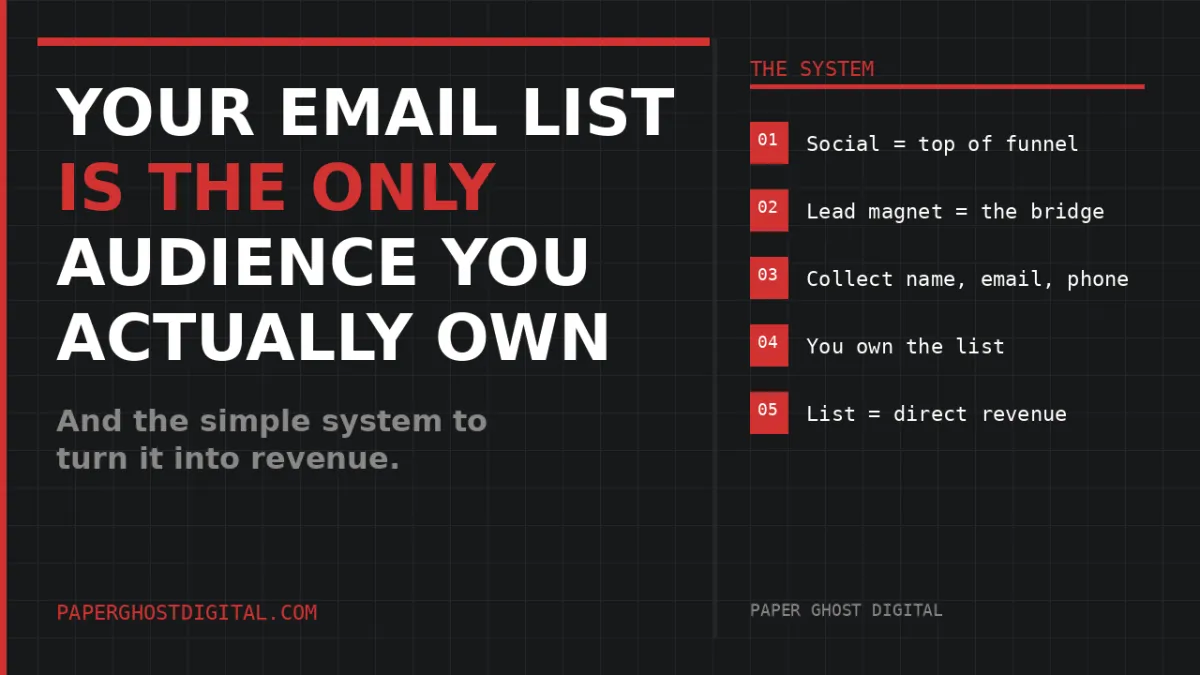
Here's how the whole thing works:
Step 1: Use social as your top of funnel. Post content. Run ads if you want. Drive awareness. Let people find you, follow you, get familiar with what you do. You're not trying to sell here — you're building visibility.
Step 2: Have a lead magnet ready. A lead magnet is a free offer that bridges the gap between "follower" and "contact on your list." It could be a challenge, a guide, a short course, a checklist, a book at a low price point. The job of the lead magnet is to give someone a real reason to hand over their information.
This is where most businesses drop the ball. They either don't have a lead magnet at all, or they have a generic "subscribe to our newsletter" form that nobody fills out. Your lead magnet needs to deliver actual value.
For us, it's the Local Lead Machine Challenge. Someone finds us on social, hears that we help local businesses get leads through Meta ads, and then we offer them something free: a 30-day challenge where we walk them through the exact system we use. They get the framework, the process, the methodology — all of it, free.
Step 3: Collect the contact. When someone signs up for the lead magnet, they give you their name, email, and phone number. Most people don't think of that as a "cost." They think "oh, it's free" — and they're right, it cost them nothing financially. But you now have a contact. A real one. On your list. That you own.
There's a $27 conversion kit offer on the back end of our challenge funnel. It exists mainly to offset the cost of any ads we run. But the primary goal isn't the $27. The primary goal is the contact.
Step 4: Deliver the value. During the 30 days of the challenge, those people are getting real results. They're implementing. They're seeing what's possible. And in their mind, they went from "random person on social" to "someone who actually helped me." That repositions you from vendor to trusted resource.
Step 5: Market to the list. Now you have a warm audience you can reach anytime. Newsletter. Offer. Event. Follow-up from your sales team. Booking a call. Whatever makes sense. We have a sales rep who touches base with people while they're mid-challenge — not to hard sell, just to show up as a resource. By the time any kind of ask comes, the relationship is already there.
Why This Matters More Than Your Follower Count
Ten thousand followers on Instagram sounds impressive. But if Instagram goes down tomorrow, or your account gets flagged, or the algorithm tanks your reach — what do you have?
A list of 500 people who opted in, know who you are, and have already gotten value from you? That's worth more. That's a real asset.
Social platforms are for discovery. Your email list is for retention, relationship, and revenue.
Build both. But understand which one you actually own.
The Fast Version of the System
Top of funnel: Social media content (and/or paid ads)
The bridge: Lead magnet that delivers real value for free
The conversion: Collect name, email, phone
The nurture: Deliver on the promise, build the relationship
The revenue: Market to the list directly — offers, calls, upsells
That's it. That's the system. Most small businesses don't have it. The ones that do have a real competitive advantage because they're not starting from zero every time the algorithm changes.
Build the list. Own the audience.