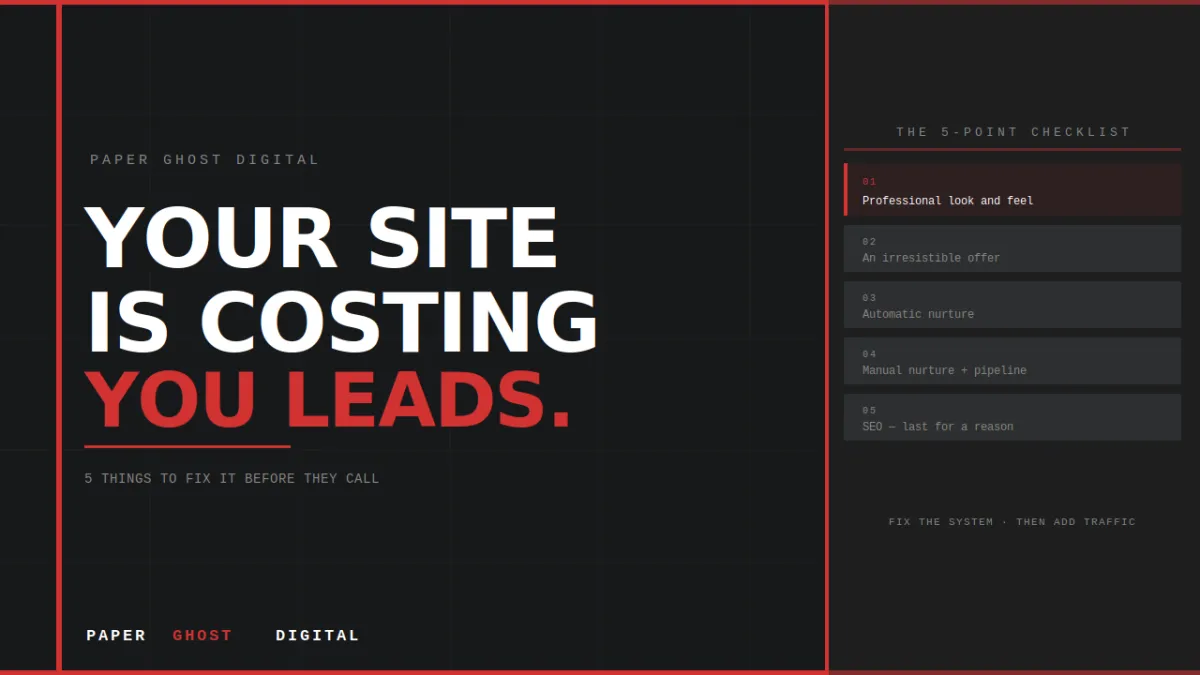
WHY YOUR WEBSITE IS LOSING YOU CUSTOMERS BEFORE THEY EVER CALL — AND THE 5 THINGS TO FIX IT
WHY YOUR WEBSITE IS LOSING YOU CUSTOMERS BEFORE THEY EVER CALL — AND THE 5 THINGS TO FIX IT
Most local businesses think their website is fine.
It isn't.
Not because it's ugly necessarily. But because looking decent and actually converting visitors into leads are two completely different things. A website can look passable and still be bleeding customers every single day — people who found you, looked around for thirty seconds, and left without ever reaching out.
Here's why that happens and exactly what to do about it.
1. Your website has to look professional — and this one is non-negotiable
Everything else on this list is pointless if you skip this one. A website that looks dated, has broken links, or sends people to a personal Gmail address with a nickname in it is not going to convert. People make up their minds about whether a business is legitimate in about three seconds. That's not an exaggeration — that's the reality of how people browse in 2026.
This doesn't mean you need the most expensive website on the market. It means clean, fast, mobile-friendly, and professional. It means a business email address, not [email protected]. It means no broken pages, no stock photos from 2009, no text that runs off the screen on a phone.
If your site was built ten years ago and nobody has touched it since, there's a good chance it's working against you. Things have changed — not just visually but technically. Sites function differently now. Customers expect more. And if what they land on doesn't match that expectation, they're gone before they even read your headline.
Get this right first. Then worry about everything else.
2. You need a real offer — not a contact form
Here's something most business owners get wrong: they put a contact form on their website and call it a lead capture strategy.
Nobody is filling out your contact form unless they've already made up their mind to hire you. And if they've already made up their mind, you probably didn't need the form — they would have called anyway.
What you actually need is an offer. Something specific and valuable that gives a visitor a reason to hand over their contact information before they're ready to buy.
For a clothing brand that might be 20% off the first order. For a local service business it might be a free consultation or a free audit. For a retail store it might be a giveaway.
Speaking of giveaways — this is one of the most underused tools in local business marketing. Pick something your ideal customer actually wants. Five hundred dollars in store credit. A free service. A gift card. Put it on your website as the entry mechanism. Someone lands on your page, sees the giveaway, enters their name, email, and phone number to win. Now they're on your list.
You draw a winner every 90 days. Everyone else stays in your marketing ecosystem receiving your offers, your new arrivals, your promotions. You paid roughly $500 every quarter to build a list of people who already told you they want what you sell. That is cheaper than most ad campaigns and far more targeted.
The point is this: give people a reason to say yes before they're ready to buy. That's how you build a list. That's how you stay in front of them until they are ready.
3. Automatic nurture — follow up without lifting a finger
Once someone gives you their information, something needs to happen immediately. Not tomorrow. Not when you get around to it. Immediately.
This is where automation comes in. A system like GoHighLevel can trigger a text message and an email the moment someone fills out your form or enters your giveaway. That automated sequence confirms they're in your world, sets expectations, and keeps them warm while you get ready to follow up personally.
A good email nurture cadence for most local businesses is once a week. One email that leads with pure value — a tip, a resource, something genuinely useful related to your business. No pitch, no ask. Just value. The second email of the week, if you're sending twice, can include a soft call to action at the end. Something like hey if you're ready to take the next step here's how we work together.
The key word is soft. You're building trust, not closing on the first date.
Think of automation as the system that makes sure nobody falls through the cracks between the moment they raise their hand and the moment a human actually talks to them.
4. Manual nurture and a pipeline — this is where the money actually is
Automation starts the conversation. A human closes it.
This is the piece most businesses either skip entirely or do halfway. They set up an automated sequence, it fires off a few messages, and then nothing. No human follow-up. No phone call. No pipeline to track where people are in the process.
Here's the standard to hold yourself to: when a new lead comes in, you or someone on your team should be reaching out within five minutes. Not an hour. Not the next morning. Five minutes.
The reason is simple. In 2026 the attention span of a buyer is about three seconds. When someone reaches out to you they've probably reached out to two or three competitors at the same time. Whoever responds first has the advantage. Most businesses respond last.
A pipeline makes this manageable. A pipeline is just a visual board — you can build one in GoHighLevel, in a basic CRM, or even a spreadsheet — that shows you exactly where every lead is in your process. Who just came in. Who you've called. Who you're waiting to hear back from. Who's close to closing.
When a new lead comes in they go in the first column. You call them, no answer, you move them to contacted and set a task to follow up tomorrow. You keep moving them through the pipeline until they close or tell you no.
Nothing falls through the cracks. Nothing gets forgotten. The leads you're losing right now aren't gone — you just stopped following up too early.
5. SEO — powerful, but only after the other four are in place
Everyone wants to talk about SEO first. Rank higher, get more traffic, be number one on Google.
Here's the honest truth about SEO: it is gasoline. And you do not pour gasoline on a fire that doesn't exist yet.
If someone finds you on Google and lands on a website that fails point one — it looks unprofessional — they're gone. If there's no offer to capture them — they're gone. If the automated follow-up doesn't fire — they're gone. If no human reaches out — they're gone.
SEO without the other four things in place just means more people going through a broken process faster. You can have the best search ranking in your market and still make zero sales if the system behind your website isn't working.
Fix the foundation first. Then invest in SEO. Because once those four things are dialed in, every visitor that SEO sends you has a real chance of converting. The traffic you're already getting — from Google, from ads, from word of mouth — will start closing at a dramatically higher rate simply because you fixed the process behind it.
One more thing worth mentioning: your website doesn't operate in isolation. Before someone even clicks through to your site they've likely checked your Google Business Profile and your Facebook page. If your GBP has three reviews and wrong hours listed, you're losing people before they get to your site at all. If your Facebook page hasn't been updated in two years it signals that the business might not even be active.
Your website, your GBP, and your social presence should all tell the same story. Professional, active, credible. If one of them is broken the whole thing leaks.
The bottom line
Your website is either working for you or against you. There is no middle ground.
Fix the look. Build a real offer. Set up automatic follow-up. Add human follow-up and a pipeline. Then invest in SEO to pour fuel on a system that's actually working.
Do those five things in that order and your website stops being a business card and starts being your best salesperson.